
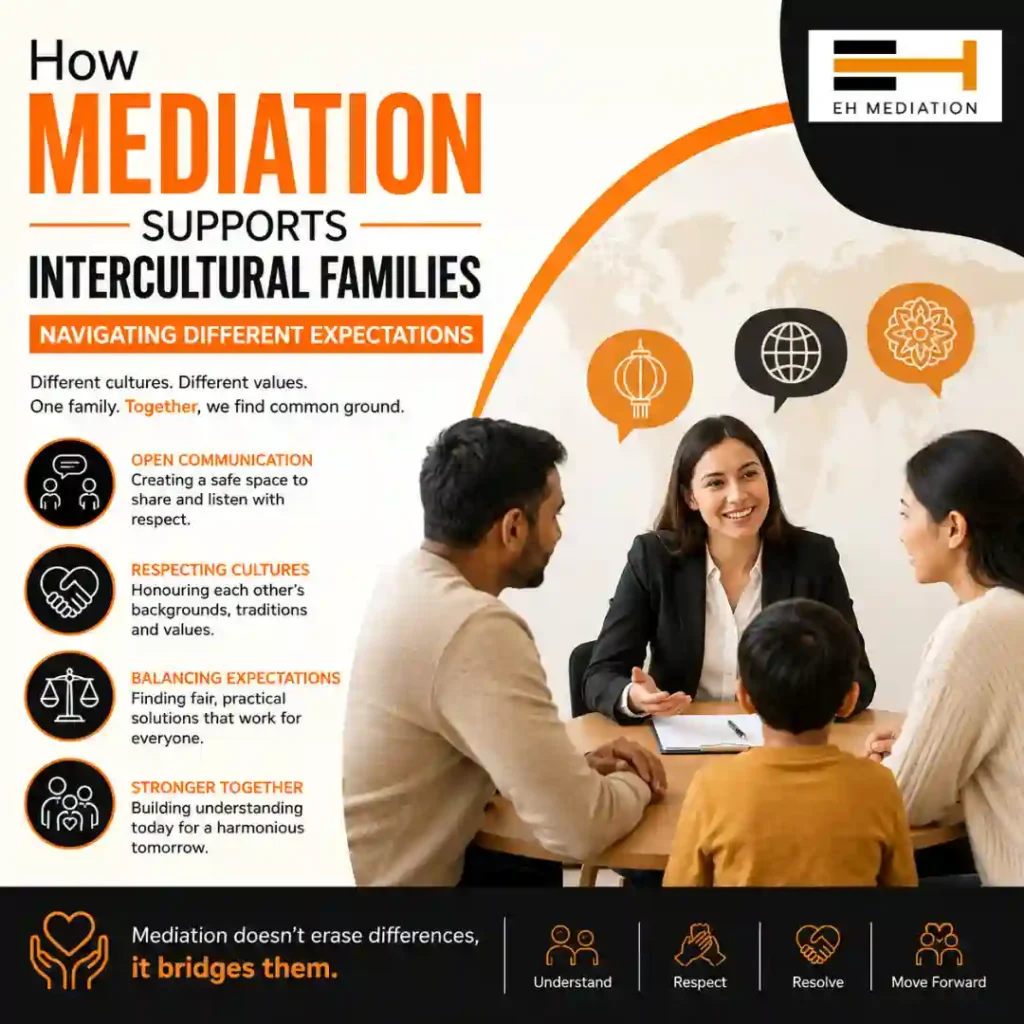
Intercultural families often bring together different traditions, languages, family expectations and ways of looking at everyday life. These differences can be a wonderful part of family life, but they can also become difficult when people disagree about important decisions.
Questions about parenting, relationships, finances, religion, family traditions and separation can become particularly sensitive when each person has grown up with different expectations of what family life should look like.
The problem is not necessarily that one person is right and another is wrong. Sometimes, people have very different ideas about what is normal, respectful or appropriate.
This is where family mediation can provide a calmer way forward.
When family disagreements become difficult to manage, EH Mediation Hampshire gives everyone a safe and impartial space to talk openly, understand each other’s concerns and explore practical ways forward.
Why Intercultural Family Disagreements Can Feel So Difficult to Resolve
Every family has its own expectations, but cultural differences can add another layer to disagreements.
One parent may have grown up believing that children should follow strict routines and respect traditional family structures, while the other may prefer a more flexible approach. One person may expect grandparents and wider relatives to have a significant role in family decisions, while another may believe those decisions should remain between the parents.
Neither perspective automatically makes someone unreasonable. The difficulty arises when these expectations are not discussed openly.
What might start as a simple difference of opinion can sometimes turn into a much bigger family issue. Couples may find themselves disagreeing about:
- The way their children should be brought up
- Which cultural traditions to pass on
- The role grandparents and relatives should play
- Where children spend school holidays and special occasions
- How birthdays, festivals and other celebrations are handled
- Which languages children hear and speak at home
- Managing money and household responsibilities
- What arrangements would work if the relationship ends
Over time, repeated disagreements can leave one or both people feeling that their culture, family values or personal choices are not being understood or respected.
Related reading
If you are trying to understand how Islamic divorce and UK family law can work alongside each other, explore Family Mediation for Muslim Couples — Talaq, Islamic Divorce and UK Law
Mediation Hampshire can help bring the conversation back to the practical issues that need resolving.
Instead of focusing on who is to blame, mediation encourages participants to consider what would work best going forward.

Different Parenting Styles and Expectations: Finding Common Ground Through Mediation
Parenting can become one of the most sensitive areas of disagreement in an intercultural family.
Parents may have completely different ideas about discipline, education, independence, boundaries and the involvement of relatives.
For example, one parent may value a highly structured approach to education, while the other may place greater emphasis on independence and personal choice.
There are many areas of everyday family life where cultural backgrounds and personal experiences can lead to different expectations, such as:
- School and learning: Parents may have different priorities when it comes to education, homework, school choices and extracurricular activities.
- Family routines: Mealtimes, bedtimes, screen time and household responsibilities may be approached differently by each parent.
- Rules and discipline: Parents may have contrasting views about setting boundaries, responding to behaviour and using consequences.
- Growing independence: One parent may encourage independence earlier, while the other may prefer closer guidance and supervision.
- Relationships with relatives: There may be different expectations around how often children see grandparents, aunts, uncles and other members of the wider family.
- Celebrations and holidays: Families may have different traditions around holidays, special occasions, travel and visits to relatives.
- Cultural and religious traditions: Parents may have different wishes about introducing children to cultural customs, religious beliefs or family traditions.
- Language and identity: Parents may disagree about which languages children should speak, learn or use within the home.
These differences can become even harder to manage when parents separate, particularly when decisions about the children’s future still need to be made together.
Parents may worry that agreeing to something means giving up an important part of their culture or their relationship with their children.
Related reading
If you are navigating separation and want to understand how to keep your child’s needs at the centre of important decisions, explore Child-Focused Separation in the UK: What Every Parent Needs to Know?
Family mediation provides an opportunity to explore these concerns without turning every disagreement into a confrontation.
The focus can be on creating practical arrangements that recognise both parents’ perspectives while keeping the children’s best interests at the centre.
A mediator does not decide which parenting culture is superior. Instead, they help parents communicate and explore whether a workable middle ground exists.
When Cultural Traditions, Family Values and Personal Choices Collide
Cultural traditions can be incredibly important to families.
However, traditions can sometimes become a source of tension when partners or relatives have different expectations.
One person may expect particular celebrations, ceremonies or family gatherings to be treated as essential. Another may not have the same connection to them.
What looks like a disagreement over one family occasion can sometimes be about something much deeper—feeling valued, understood and respected.
One person might think:
“You’re not recognising how important my family traditions are.”
While the other might feel:
“I need my own choices and values to be respected too.”
When emotions become attached to cultural expectations, conversations can quickly become difficult.
Mediation can help separate the underlying concerns from the immediate disagreement.
Rather than arguing about whose tradition should win, participants can explore questions such as:
- What is particularly important to each person?
- Which traditions could be maintained?
- Where might some flexibility be possible?
- How can children experience both sides of their family background?
- Can practical arrangements reduce future disagreements?
This can make it easier to find solutions that respect differences rather than attempting to eliminate them.

Communication Barriers in Intercultural Families—and How Mediation Can Help
Communication problems do not always mean that people cannot speak the same language.
People can speak the same language and still communicate very differently.
Different cultures may influence how people express disagreement, show respect, discuss emotions or approach difficult conversations.
For example, one person may prefer to discuss a problem immediately and openly. Another may need more time before feeling comfortable having that conversation.
When there is already tension within a family, words can easily be taken the wrong way. One person might think they are simply speaking honestly, while the other may feel judged, criticised or disrespected.
Mediation provides a structured setting for these conversations Hampshire.
Instead of repeatedly having the same argument at home, participants have an opportunity to identify the actual issues, listen to each other’s concerns and consider practical options.
Where appropriate, participants can also discuss communication preferences and what they need from each other to make future conversations more manageable.
The aim is not to force people to communicate in the same way.
It is to create enough understanding for them to communicate about the issues that matter.
Managing Pressure From Extended Family Without Making Conflict Worse
Extended family can play an important role in intercultural relationships.
Grandparents, siblings, parents and other relatives may provide emotional support, childcare and practical help. In some families, their involvement is an expected part of family life.
However, disagreements can arise when relatives have strong opinions about decisions that directly affect a couple or their children.
For example, relatives may have expectations about:
- Where children should live
- How children should be raised
- Which traditions should be followed?
- Family celebrations
- Financial responsibilities
- Contact with grandparents
- What should happen after separation?
This can leave couples feeling caught between their partner and their wider family.
Mediation Hampshire can help the people directly involved identify what decisions need to be made and establish clearer boundaries around those decisions.
Related reading
If you have reached an agreement through mediation and want to understand how it can be formalised and made legally binding, explore How to Make Your Mediation Agreement Legally Binding with a Consent Order.
It can also help participants discuss how children can maintain meaningful relationships with extended family members without allowing family pressure to create further conflict.
The goal is not necessarily to exclude relatives.
It is about finding arrangements that are realistic, respectful and sustainable.
Separation, Child Arrangements and Finances: How Mediation Can Support Fair Solutions
Intercultural differences can become even more complicated when a relationship breaks down.
A separating couple may need to decide where their children live, when they spend time with each parent, holidays, travel, education, and communication.
There may also be financial and property matters to resolve.
Where family members live in different countries, parents may need to think carefully about overseas contact, travel arrangements and how children can remain connected to their cultural roots.
These discussions can feel overwhelming, particularly when emotions are still high.
Mediation can provide a structured process for working through these issues one at a time.
Related reading
If you are separating and need to work out who should be responsible for loans, credit cards or other shared financial commitments, explore Mediating Joint Debts and Shared Liabilities After Separation.
Instead of attempting to resolve everything during an emotionally charged conversation, participants can identify the key issues and consider possible arrangements.
For child arrangements, the emphasis should remain on the children’s welfare and practical needs.
For financial and property matters, mediation can give separating couples an opportunity to discuss their circumstances and explore possible agreements.
Importantly, mediation is not about forcing someone to accept an arrangement they do not consider workable.
It creates an environment for informed discussion.
If an agreement cannot be reached, participants can consider other options.
How EH Mediation Helps Intercultural Families Move Forward With Understanding
Family conflict can be exhausting, particularly when disagreements involve culture, identity, children and wider family expectations.
Trying to resolve everything through repeated arguments rarely makes the situation easier.
EH Mediation Hampshire can provide a confidential and impartial space where people can discuss difficult family issues in a more structured way.
The mediator does not take sides or decide whose culture, values or expectations are correct.
Instead, mediation can help participants:
- Explain what matters to them.
- Understand the other person’s concerns.
- Identify the issues causing conflict.
- Explore realistic options
- Focus on children’s needs where children are involved.
- Discuss parenting and family arrangements.
- Consider financial and practical issues.
- Work towards mutually acceptable solutions.
For intercultural families, this approach can be particularly valuable because the aim is not to make everyone think or behave in the same way.
Families can have different backgrounds and still find practical ways to work together.

Finding a Way Forward Without Escalating Conflict
Cultural differences do not have to become permanent sources of conflict.
Sometimes what a family needs is an opportunity to slow the conversation down, understand what is really behind the disagreement and consider what could work in the future.
Mediation can help create that opportunity.
When family disagreements become difficult to resolve alone, EH Mediation Hampshire provides a calm, impartial environment where couples and families can explore practical ways forward.
The aim is to help families move beyond conflict and find practical solutions that respect everyone’s experiences, values and expectations.
Frequently Asked Questions
Q: Can mediation help when parents have very different cultural views about raising their children Hampshire?
Yes. Family mediation can help parents discuss cultural differences, parenting preferences and day-to-day arrangements in a constructive setting. The aim is to reach practical solutions that prioritise the children while taking both parents’ backgrounds into account.
Q: What if cultural or religious differences are causing arguments between family members?
Mediation can help family members discuss sensitive subjects in a controlled and respectful environment. The aim is not to decide which belief or tradition is correct, but to understand the concerns involved and explore practical ways forward.
Q: Can mediation help if extended family members are influencing decisions?
Yes. Extended family can be important, but disagreements may arise when relatives have strong opinions about parenting, relationships or separation. Mediation can help the people directly involved clarify their own priorities and establish practical arrangements.
Q: What happens if one person feels their culture is not being respected?
This can be discussed during mediation. Each person has the opportunity to explain what is important to them and why. Understanding the meaning behind a particular expectation can sometimes make it easier to identify compromises or alternative arrangements.
Q: Can intercultural couples use mediation when they are separating Hampshire?
Yes. Mediation can help separating couples discuss issues such as child arrangements, finances, property and future communication. It can also provide an opportunity to consider practical issues that may be particularly important to an intercultural family.
Q: Why choose EH Mediation Hampshire for an intercultural family dispute?
EH Mediation Hampshire provides an impartial and structured setting for difficult conversations. Rather than taking sides, mediation helps participants communicate their concerns, consider different perspectives and work towards practical solutions where possible.
For Further Information Please Contact Us